Will new technology fix a business that isn’t growing? Not on its own. People, process and technology (at Cogent we say people, processes and systems) only produce sustainable growth when they are aligned. Buy systems first and you tend to get expensive tools with low adoption, inconsistent processes and frustrated employees. Bring your people with you, sort out your processes, and then use systems to support them.
What goes wrong with a system-first approach?
A system-first approach assumes the right tools will solve the problem. Under pressure to deliver quick results, many companies invest heavily in CRMs, automation platforms or analytics suites. Often the outcome is an expensive system with low adoption, inconsistent processes and frustrated employees, because the tools leave the core issues untouched.
New technology is appealing because it is tangible: you can buy it, install it and demo it. Yet despite significant investment in digital transformation, many organisations end up “busy but not better”. They have more tools, but the misalignment between people, processes and systems remains, and that misalignment shows up as inefficiency, silos and stalled growth.
What is The APPS Principle™?
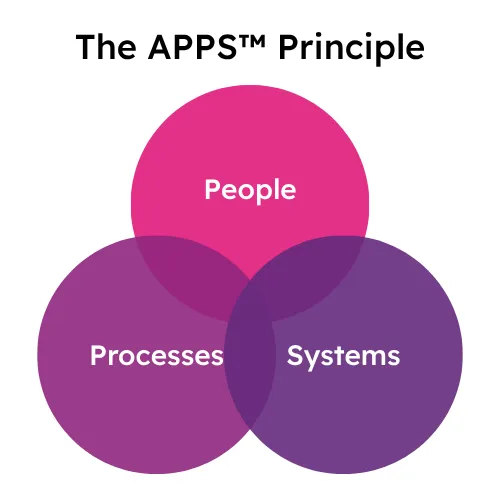
The APPS Principle™ (Alignment of People, Processes and Systems) is Cogent’s framework for sustainable growth. It holds that lasting success is only possible when three pillars are aligned: people, processes and systems. Treat them in isolation and the investment is wasted. Align them, and you build a foundation for growth that compounds year after year.
| Pillar | What it covers | What goes wrong when it is ignored |
|---|---|---|
| People | The humans who drive adoption, carry out the strategy and bring systems to life | Resistance, low adoption, workarounds on the side |
| Processes | The workflows, practices and habits that create structure and consistency | Duplicated work, missed handoffs, inconsistent customer experiences |
| Systems | The technologies that support and amplify people and processes | Silos, and “faster chaos” when broken processes are automated |
At Cogent, The APPS Principle™ is the basis of the assessment in Diagnose, the first phase of The Cogent Blueprint™. Before a client signs, we assess the business on the APPS Principle, agree the starting Level and review every system the client runs and what it costs. The Levels run from 0 Unstructured, through 1 Foundations, 2 Process adopted and 3 Connected, to 4 AI-led, and each engagement moves a client up one Level.
Why do people come first?
Every system, process and initiative relies on people. You can map the best workflows and deploy the most advanced technology, but if the people doing the work don’t understand it, adopt it or believe in it, the whole effort collapses. Resistance to new systems is natural, so it has to be planned for rather than discovered late.
Resistance usually comes from fear of disruption. Employees worry about being replaced, or about being judged for struggling to adapt. Leaders who overlook this are often surprised when adoption falters.
Organisations that get this right:
- bring people into the process early, involving them in system design and process improvement;
- communicate the benefits of the change clearly;
- show visible leadership commitment to it.
We cover this in more depth in why you should include your employees in a process review and why a people-centric approach matters in system implementation.
Why should you fix processes before automating them?
Processes are the bridge between strategy and execution: they decide whether good intentions turn into consistent results. Automation is only valuable if the underlying process is efficient. Streamline first, and technology accelerates value; automate first, and it accelerates waste. Without clear processes, organisations drift into duplicated work, missed handoffs and inconsistent customer experiences.
The temptation in any digital transformation is to automate quickly. Instead:
- Map your current workflows.
- Identify the gaps and inconsistencies.
- Involve the people who do the work in the redesign.
- Then apply the technology.
How should systems fit in?
Systems should enable change, not drive it. They work best on a foundation of aligned people and sound processes, because technology amplifies whatever process it is given. Automating a broken process just creates “faster chaos”. Choose systems that fit your workflows and connect to the rest of your stack.
When choosing a system, evaluate:
- Fit with your workflows. Does it match how your redesigned processes actually run?
- Scalability. Will it cope as the business grows?
- Integration. A system that can’t integrate with your other tools creates silos.
- Usability. Will your people actually use it?
The aim is a technology stack that works together and gives every team a single source of truth. That usually means looking beyond the CRM to how it connects with your ERP, finance and other systems, which is covered in how to end manual processes and siloed systems.
What does alignment look like in practice?
Alignment means treating a disappointing system as a people and process problem first. In one example, a mid-sized B2B services company bought a powerful, well-regarded CRM to fix declining sales productivity. The technology wasn’t faulty, but it was misaligned with the company’s people and processes, so it failed. The fix was to work on those first.
Within six months the CRM had become a graveyard of half-filled records. Reps kept spreadsheets on the side and managers pulled numbers manually.
Applying the APPS Principle, the company:
- ran workshops with sales reps to understand their frustrations;
- redesigned training to be role-specific;
- coached managers to use CRM data in their coaching conversations;
- standardised processes across departments;
- reconfigured the CRM to match the redesigned workflows.
If your organisation has invested in systems but isn’t seeing the results you expected, start by aligning your people and your processes, then treat systems as the enabler. Cogent’s audit and scoping work is where that starts, or you can book a call to talk it through.
Questions people also ask
Why do new CRM systems often fail to improve results?
Because the system is bought before the people and processes are ready for it. The technology itself is rarely faulty. Without buy-in, people keep spreadsheets on the side and managers pull numbers manually; without sound processes, automation just speeds up the waste. The result is an expensive system with low adoption and a team that is busy but not better.
Should we automate our processes as soon as we have a new system?
Not straight away. Automation only adds value if the underlying process is efficient, and automating a broken process just creates faster chaos. Map your current workflows first, identify the gaps and inconsistencies, redesign them with the people who do the work, and then apply the technology.
How does Cogent use The APPS Principle™ in a project?
It is the basis of the assessment in Diagnose, the first phase of The Cogent Blueprint™. Before a client signs, Cogent assesses the business on The APPS Principle™, agrees the starting Level and reviews every system the client runs and what it costs. Each engagement then moves the client up one Level.
What should we look for when choosing a new system?
Evaluate how well it fits your workflows, how it scales, how it integrates with your other tools and how easy it is to use. A system that cannot integrate with the rest of your stack creates silos, so aim for a set of tools that work together and give every team a single source of truth.